Concrete batching plant for ready-mix suppliers
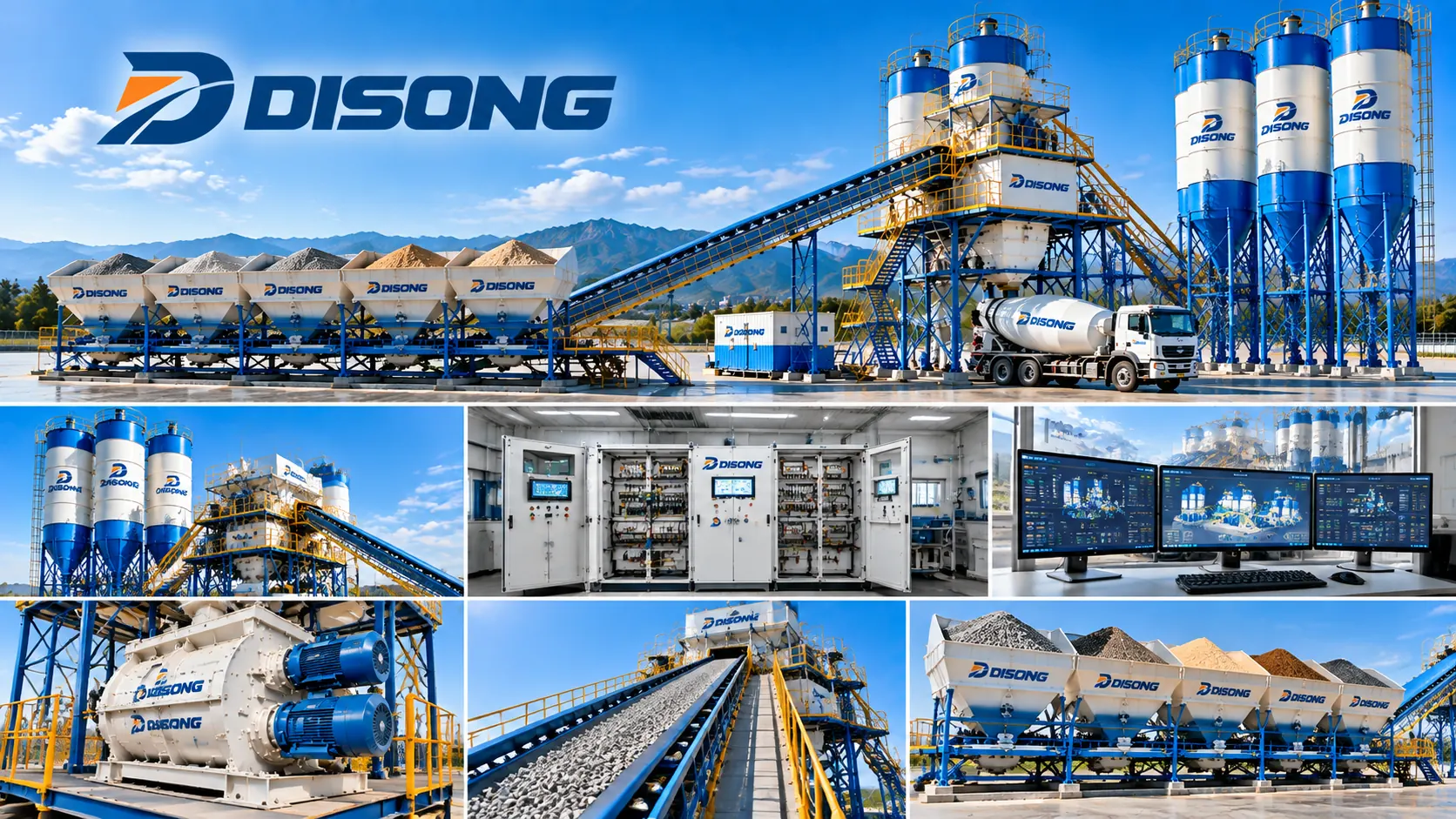
A ready-mix yard is judged by the truck cycle: the plant has to keep the fleet loaded without making drivers wait, and it has to hold enough cement to keep batching when a delivery runs late. Both of those are decided at the order, not on the first busy morning.
Capacity follows the fleet, not the average day
Take the number of trucks you keep on the road and the round-trip time to the customers you serve, and the plant has to cover that peak — an average-day figure will leave trucks queuing at exactly the hour you cannot afford it. This is the shortlist most yards come back with:
| Model | Capacity (m³/h) | Mixer | Aggregate batcher | Cement silo | FOB price from |
|---|---|---|---|---|---|
| HZS60 | 60 | JS1000 | PLD1600 | 2 x 80 t | US$110,000 |
| HZS90 | 90 | JS1500 | PLD2400 | 2 x 100 t | US$126,000 |
| HZS180 | 180 | JS3000 | PLD4800 | 3 x 150 t | US$238,000 |
Sizing when the order book grows faster than the yard
Bulk cement is the side of the market that is growing, and bulk is what a ready-mix yard sells. Indonesian domestic cement consumption in the first nine months of 2026 came to 48.1 million tonnes, 7.9% up on the same period a year earlier, with bulk up 9.3% against 7.4% for bagged (Mirae Asset Sekuritas Indonesia, 21 October 2026, on Indonesian Cement Association volumes). September sharpens the split: bulk was 1.9 million tonnes, up 8.2% year on year and rising both inside and outside Java on dry weather, project deadlines and faster year-end budget disbursement, while bagged cement grew only in Java. The same figures show the growth is not confined to the national producers — second-tier producers lifted their market share to 24.4% from 22.8%, while the largest producer's domestic share fell to 44.0%. A district yard adding a line is reading the same market as those producers, and it meets the constraint twice: first on the truck cycle, then again on the lead time between placing the order and the first batch. Size the station against the fleet you expect to run in your busiest quarter rather than the fleet you run today, and place the order early enough that commissioning lands before the peak instead of in the middle of it.
Cement storage is the quiet constraint
The silos decide whether a late delivery stops the plant. The published range runs from 2 x 80 t on the HZS60 and 2 x 100 t on the HZS90 to 3 x 150 t on the HZS180 and 4 x 200 t on the HZS240, and the useful question is not how much steel you can afford but how often your cement supplier can actually deliver and how many silos they can discharge into at once. Storage beyond that just sits full.
When the order book is precast-led rather than truck-led
The corridor work that drives Indonesian concrete is increasingly won as precast elements, and the volume mix has moved with it. WIKA Beton reported new contracts of Rp3.1 trillion in the third quarter of 2026, 57.58% above the second quarter, and stated that precast accounted for 76.98% of those new contracts while ready-mix accounted for 16.35% (WIKA Beton release, 30 October 2026). Profit for the period grew 81.46% year on year on revenue of Rp2.55 trillion. For a yard that sells to precast customers as well as to site pours, that changes what the plant is being asked to do: the mix design repeats, the tolerance is written down, and every load has to be defended against a specification rather than against a slump the driver judged on arrival.
Three things follow for the order. Moisture compensation stops being a comfort feature, because a precast customer is measuring the strength of the elements, not the look of the discharge. Batch records have to come out of the controller in a form the customer can file, since the record travels with the element. And the plant has to hold that accuracy at the pace the fleet runs, which is why the sizing question on this page is asked against the truck cycle and not against a monthly tonnage. A yard that supplies both markets usually ends up specifying one station for the specification work and reading its second line against the fleet it expects in its busiest quarter.
Mix quality and records
Materials are weighed on the plant's own scales rather than judged by eye, and the batch record is produced by the control system with the plant: what went into each load, and with which mix design. For customers who buy on specification, that record is part of the product. Aggregate moisture moves with the weather, so real-time moisture compensation and covered aggregate storage belong in the specification — a wet morning otherwise changes the mix without anyone deciding to change it.
What the site has to settle
The electrical package is built for the confirmed supply — 380–415 V / 50 Hz or 400–440 V / 60 Hz — with the connected load on the quotation. From the HZS60 upwards the aggregate yard feeds a belt conveyor; below that the mixer is charged by a skip hoist. Freight is quoted against the port you name, as separate lines for ocean freight, port handling, customs clearance and inland haulage, so the delivered cost can be audited line by line.
Growing the yard later
A station cannot be field-upgraded — capacity is set by the mixer and the aggregate batcher — so growth means adding a second plant rather than converting the first. The range runs continuously from HZS60 through HZS90 and HZS120 to HZS180 and HZS240, so the second station can be ordered to the same drawings and the same electrical standard.
Adding the second line beside a running yard
A yard that outgrows one station adds a second station beside it rather than shutting down to rebuild the first. The new line arrives as a self-contained set — aggregate batcher, belt, mixer tower and its own control system — so it is commissioned on its own and then either run independently or operated alongside the existing plant. What the site has to plan in advance is the shared ground: aggregate stockpile space and the loader route, the cement silos and their screw conveyors, and the cable route from the switchgear to both control cabins. Laid out from a site drawing, the second tower goes up without the first one stopping.
Barge-fed yards and wet aggregate
Yards in an estuary or port estate — Marunda and Cilincing in North Jakarta are the obvious examples, and the same pattern holds at Johor and along the Pasig — take aggregate by barge and store it in the open, in air that is saturated for much of the year. Sand landed that way carries several per cent of water before it is ever stacked, and the figure changes from barge to barge and again after a night of rain. The plant weighs by mass, so untreated moisture is not a cosmetic problem: it becomes extra water in the mix and short measure of actual sand, and the slump moves without anyone touching a setpoint. Metro corridors keep adding this kind of capacity — Jayamix by SCG (PT SCG Readymix Indonesia) broke ground on a new batching plant at Marunda in May 2026 (Kontan, 20 May 2026) — so the specification question is a live one rather than theoretical.
What belongs in the order is therefore three things together: real-time moisture compensation, with probes on the sand and fine-aggregate bins so the control system corrects the water and the aggregate setpoints batch by batch; stockpile bays that drain and can be covered, so a downpour is not stored in the pile for the next shift; and batch records written by the controller that state the moisture figure actually used. Ordered afterwards, the probes and the compensation logic are a retrofit; ordered with the plant, they are part of the control package.
Frequently asked questions
Which plant suits a ready-mix yard?
The truck cycle decides it. Work out the production you need at the busiest hour — the number of trucks you keep on the road multiplied by the round-trip time — and size the plant for that peak. Yards selling into a town or district typically start at the HZS60 or HZS90 and step up to the HZS180 as the fleet grows.
How much cement storage should the yard have?
Enough to keep batching when a delivery is late, and no more than your cement supplier can discharge into efficiently. The published range runs from 2 x 80 t on the HZS60 and 2 x 100 t on the HZS90 up to 3 x 150 t on the HZS180 and 4 x 200 t on the HZS240; the tonnage is the real constraint on a busy morning, not the mixer.
Does a bigger plant need a belt conveyor?
From the HZS60 upwards the aggregate arrives on a belt conveyor fed from the yard; the HZS25, HZS35 and HZS50 charge the mixer with a skip hoist. For a yard selling continuously, the belt keeps the mixer charged from bulk storage without a single hoist dictating the pace.
We expect to grow — do we buy big now?
A station cannot be field-upgraded: capacity is set by the mixer and the aggregate batcher, so growth means a second station rather than converting this one. Most yards order the size they expect to need in the near term and add capacity later as a separate plant — which is also why the published range runs continuously from the HZS60 to the HZS240.
Can we keep producing while the second plant is installed?
That is a layout question rather than a doubt about the plant. Keep the existing stockpiles and the truck circulation where they are, set the new tower on its own pad beside them, and the two lines meet only at the silo area and the switchgear. The new line arrives as modules with its own control system, so it is commissioned on its own and then run independently or alongside the existing one.
Demand rose before we ordered — what can actually be compressed?
The plant is built to the order, so the build time is the lead time stated on the quotation and cannot be shortened by asking. What can be settled early is everything around it: confirm the electrical supply (380–415 V / 50 Hz or 400–440 V / 60 Hz), lay out the aggregate yard and the truck circulation, and clear the import formalities while the plant is in production — so assembly starts the day the containers are released instead of the month after. Lead time, ocean freight and inland haulage are quoted as separate lines for that reason: the schedule can be checked before the order is placed rather than after.
Our aggregate arrives by barge and is often wet — what has to be specified?
Real-time moisture compensation, not a bigger water meter. The controller reads moisture from probes on the sand and fine-aggregate bins and corrects the water and aggregate setpoints for each batch, so a wet pile changes the measured figures rather than the mix. Specify it with the plant, together with stockpile bays that drain and the batch records that print the moisture figure used; fitted later it is a retrofit to the control system.
Contact
DISONG Equipment LLC — Wyoming Limited Liability Company. Mailing address: 525 Randall Ave Ste 100, PMB 1419, Cheyenne, WY 82001, USA. Telephone/WhatsApp: +1 (213) 879-8221. Telegram: @disong_equipment_bot. Email: sales@disongequipment.com.
See also: choosing between the models · published prices · for contractors · request a quotation.
Terms of sale
Prices are FOB port of loading. Ocean freight, destination port charges, unloading and site-specific electrical work are quoted separately per shipment. Equipment is built to order, so returns are not accepted; delivery includes warranty service and spare-parts support from DISONG Equipment LLC.