Choosing a concrete batching plant — HZS25 to HZS240 compared
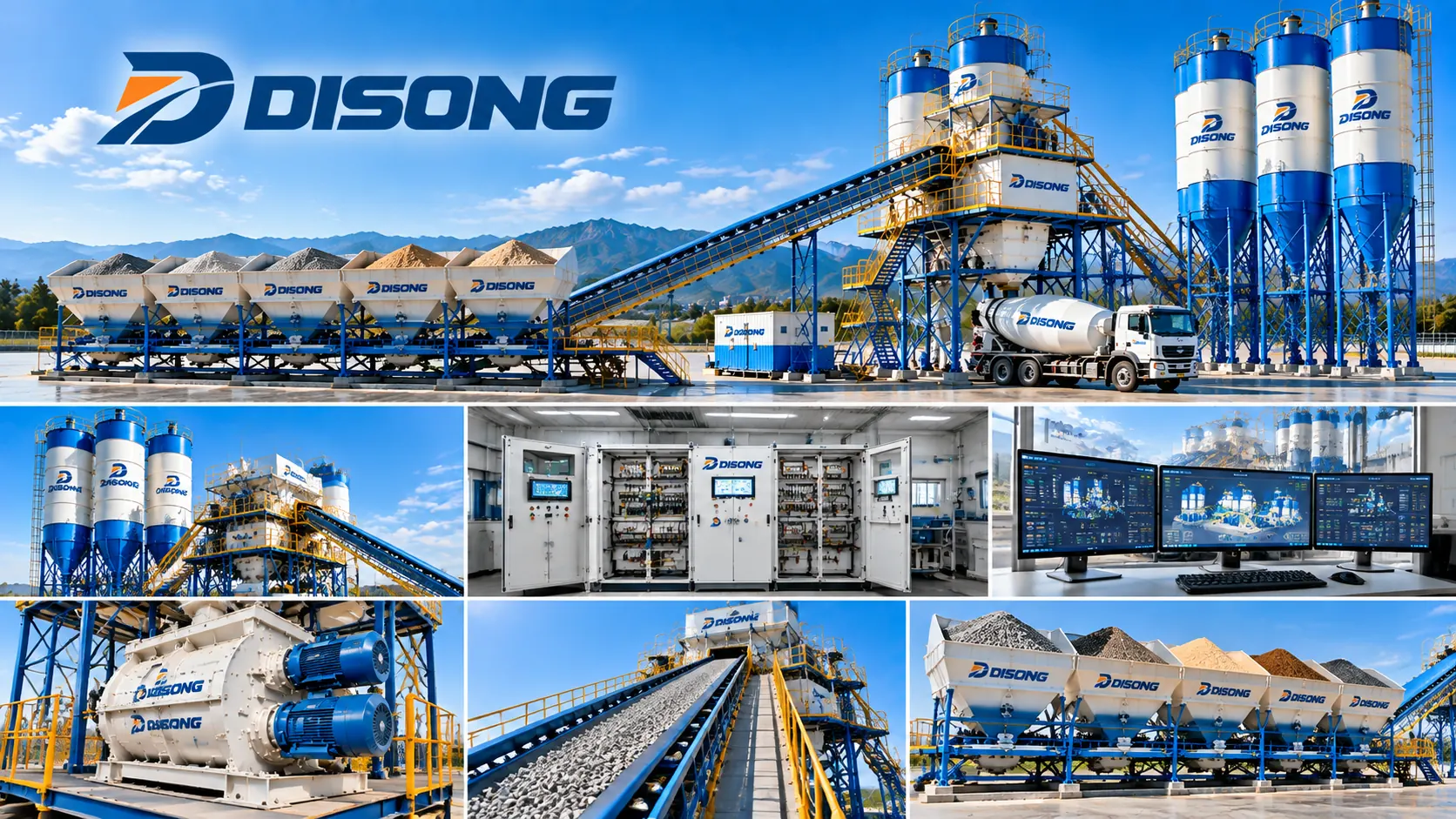
A batching plant is sized by what it has to do at the peak of a pour, not on an average day. Three questions decide most of the shortlist: the output you need when trucks are queuing, the cement storage the site needs to ride out delivery gaps, and whether the aggregate yard can feed a belt conveyor. Below are the nine models on exactly those points, with published FOB prices of US$62,000 – US$320,000 so you can see what each step costs.
The nine models side by side
| Model | Capacity (m³/h) | Mixer | Aggregate batcher | Cement silo | Aggregate loading | FOB price from |
|---|---|---|---|---|---|---|
| HZS25 | 25 | JS500 | PLD800 | 1 x 50 t | Skip hoist | US$62,000 |
| HZS35 | 35 | JS750 | PLD1200 | 2 x 50 t | Skip hoist | US$80,000 |
| HZS50 | 50 | JS1000 | PLD1600 | 2 x 80 t | Skip hoist | US$109,000 |
| HZS60 | 60 | JS1000 | PLD1600 | 2 x 80 t | Belt conveyor | US$110,000 |
| HZS75 | 75 | JS1500 | PLD2400 | 2 x 100 t | Belt conveyor | US$122,000 |
| HZS90 | 90 | JS1500 | PLD2400 | 2 x 100 t | Belt conveyor | US$126,000 |
| HZS120 | 120 | JS2000 | PLD3200 | 2 x 100 t | Belt conveyor | US$168,000 |
| HZS180 | 180 | JS3000 | PLD4800 | 3 x 150 t | Belt conveyor | US$238,000 |
| HZS240 | 240 | JS4000 | PLD6400 | 4 x 200 t | Belt conveyor | US$320,000 |
Start with the mixer, not the headline output
The mixer is the part that sets the pace, and the HZS number follows it: HZS25 carries a JS500, HZS35 a JS750, HZS50 and HZS60 a JS1000, HZS75 and HZS90 a JS1500, HZS120 a JS2000, HZS180 a JS3000 and HZS240 a JS4000. Two models can share a mixer and differ elsewhere — the HZS50 and HZS60 use the same JS1000 mixer and the same PLD1600 batcher, and the difference between them is how the aggregate gets to the mixer, which is also what produces the 50 versus 60 m³/h rating.
Skip hoist or belt conveyor
This is the real fork in the range. The HZS25, HZS35 and HZS50 lift aggregate in a skip hoist: less yard, no conveyor structure, and a smaller footprint for a compact or shifting site. From the HZS60 upwards the aggregate arrives on a belt conveyor fed from the yard, which is what keeps a larger plant charged without waiting on a single hoist. If your aggregate storage is far from the mixer, or the yard layout changes between projects, settle this point early — it decides more of the site plan than any other choice.
How much cement storage
The silos are what absorb the gap between cement deliveries: from 1 x 50 t on the HZS25 up to 4 x 200 t on the HZS240. A plant with too little storage stops when a delivery is late; a plant with too much carries idle steel. Match the tonnage against how often you can realistically receive cement, and against how many silos your cement supplier can discharge into at once.
What the site decides
Capacity is only half the order. The electrical package is built for the confirmed site supply — 380–415 V / 50 Hz or 400–440 V / 60 Hz — and the connected load for your configuration is stated on the quotation. Aggregate moisture changes with the weather, so real-time moisture compensation and covered aggregate storage are specified together. Freight is quoted against the destination port you name, as separate lines for ocean freight, port handling, customs clearance and inland haulage.
Choosing by project type
Contractors producing for their own projects usually shortlist the HZS50, HZS75 and HZS120; ready-mix yards selling to the market usually begin at the HZS60 and move up to the HZS90 or HZS180. Both routes, and the moving-between-projects case, are set out on batching plants for contractors and for ready-mix suppliers.
When the plant sits inside a precast factory
A precast producer buys a batching plant for a different job from a ready-mix yard. The concrete goes into moulds and a casting line on a fixed cycle rather than into a truck that may wait at the gate, and the station usually stands inside the factory, under the overhead crane. In October 2026 PT HSG Material Indonesia inaugurated a plant in the Kendal special economic zone in Central Java, an investment reported by ANTARA at Rp710 billion; the same report gives the scope as prefabricated pipe piles, prefabricated square piles and precast concrete, with a planned annual sales capacity of three million metres of concrete piles and 150,000 square metres of ready-to-use concrete. That description of a plant is what a captive station has to serve.
What changes when the concrete goes into moulds
Three points move. The mixer is chosen for the cycle the casting line keeps, so repeatability from one batch to the next counts for more than the headline output — a JS1500 behind the HZS75 or HZS90, or a JS2000 behind the HZS120, is the usual landing point for a factory that runs moulds all shift. The cement storage stops being a buffer against late deliveries and becomes a production constraint: the tonnage that matches a yard's truck schedule is not the tonnage that keeps a casting line fed, and the silo arrangement is worth settling against the daily consumption rather than against the delivery interval. The discharge has to reach the transfer that feeds the moulds, so the plant outline, the height of the skip or belt side and the position of the discharge point are planned with the factory drawing — a station inside a building is laid out around the crane and the mould beds, not around lorry access.
Precast mixes are usually stiffer than a ready-mix yard's, and stiff mixes are where aggregate moisture shows first: real-time moisture compensation and covered aggregate storage are specified together, and the control system records the weights actually batched so a mould can be traced back to its batch. Curing also takes floor space, so the station outline and the curing beds are settled together — they compete for the same slab.
Frequently asked questions
How do I choose between the HZS models?
Three questions settle most of it: how many cubic metres you must produce at the peak of a pour rather than on average, how much cement storage the site needs to ride out delivery gaps, and whether the aggregate yard can feed a belt conveyor. The table above lines the nine models up on exactly those points, so a shortlist is usually two or three models.
Is a batching plant a field upgrade — can I start small and grow?
No. A station's capacity is set by its mixer and its aggregate batcher: a JS1000 mixer cannot be turned into a JS2000 in the field, and the batcher, silo and frame change with it. Operators who expect to grow usually order the size they expect to need, and add a second station later rather than rebuilding this one.
Which models load aggregate with a skip hoist and which with a belt?
The HZS25, HZS35 and HZS50 charge the mixer with a skip hoist; from the HZS60 upwards the aggregate arrives on a belt conveyor. A skip hoist needs less yard and no conveyor foundation, which is why it suits the smaller stations and tight sites.
Does a precast factory need a different batching plant from a ready-mix yard?
The equipment is the same family; what changes is how it is sized and specified. A captive plant feeds a casting line on a fixed cycle rather than trucks at a gate, so the mixer is chosen for repeatability from one batch to the next, silo tonnage becomes a production constraint instead of a delivery buffer, and the plant outline is planned around the factory crane and the mould layout rather than around lorry access. PT HSG Material Indonesia's plant in the Kendal special economic zone in Central Java, inaugurated in October 2026 at a reported Rp710 billion, is a recent example of that shape: prefabricated pipe piles, prefabricated square piles and precast elements, with a planned annual sales capacity of three million metres of concrete piles and 150,000 square metres of ready-to-use concrete, as reported by ANTARA.
What has to be confirmed before I order?
The site supply (voltage and frequency), the aggregate yard and storage layout, the destination port and the site access for unloading. Send those with the capacity you need and the configuration — including the delivered cost — comes back as a quotation.
Contact
DISONG Equipment LLC — Wyoming Limited Liability Company. Mailing address: 525 Randall Ave Ste 100, PMB 1419, Cheyenne, WY 82001, USA. Telephone/WhatsApp: +1 (213) 879-8221. Telegram: @disong_equipment_bot. Email: sales@disongequipment.com.
See also: price list · the plant running on film · how a plant ships · Indonesia · Malaysia · request a quotation.
Terms of sale
Prices are FOB port of loading. Ocean freight, destination port charges, unloading and site-specific electrical work are quoted separately per shipment. Equipment is built to order, so returns are not accepted; delivery includes warranty service and spare-parts support from DISONG Equipment LLC.