Concrete batching plants for Indonesia — HZS25–240 for ready-mix and infrastructure work
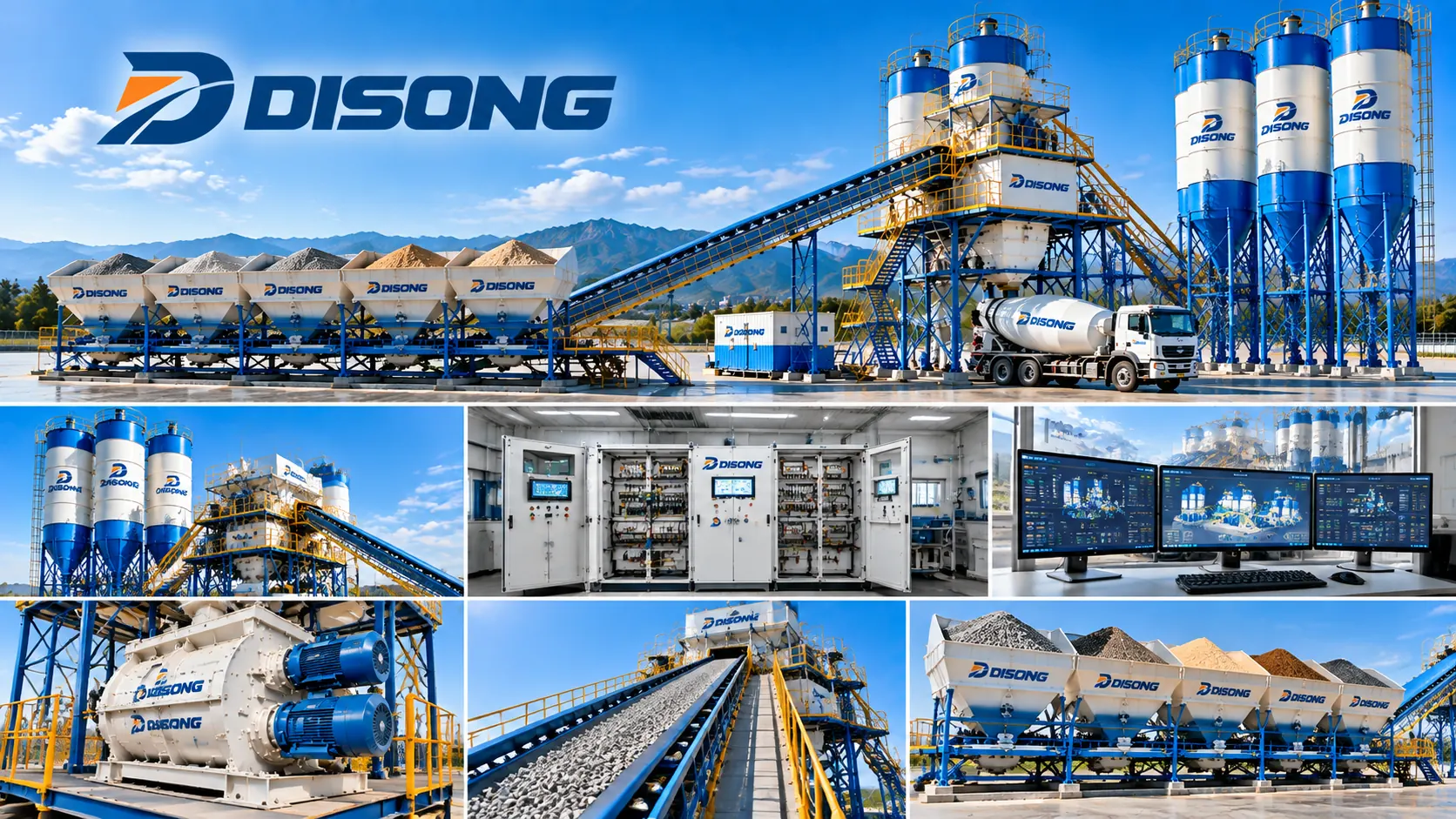
Indonesian projects combine high ready-mix demand with year-round humidity, heavy rainfall and inter-island logistics, so capacity selection, moisture compensation and the destination port are settled before the quotation is issued.
The range we supply
Nine models from HZS25 (25 m³/h) to HZS240 (240 m³/h), with published FOB prices from US$62,000 to US$320,000 for the standard configuration — the full table is on the price page. Every plant ships containerised, broken down so the modules follow the site assembly sequence and can be moved on to the next project.
Power supply
Indonesian installations normally need a 380 V / 50 Hz three-phase review; motors, control voltage, earthing and protection follow the confirmed site supply.
Climate and site conditions
Specify rainfall and humidity, corrosion protection, covered aggregate storage, site drainage and real-time aggregate moisture compensation.
Ports and inland transport
Jakarta / Tanjung Priok, Surabaya / Tanjung Perak or another destination port — plus the inter-island leg, unloading crane capacity and site access — are confirmed before freight is quoted.
Import documents and standards
Import approval is the Indonesian importer's step: depending on the category, items can fall under SNI requirements and importer licences, and any conformity assessment or registration is filed by the importer of record. We prepare the equipment documents — specification, drawings, packing list and electrical data — that go into those filings, and we do not issue import approvals ourselves.
Sizing on the year, not the hour
On 27 October 2026 a listed Indonesian precast producer said it had built a dedicated batching plant at Magelang in Central Java to supply ready-mixed concrete for Section 3 of the Yogyakarta–Bawen toll road, rated at up to 88,704 cubic metres a year, placed close to the works so that production and delivery stay efficient, and substituting fly ash for part of the cement (IDXChannel, 28 October 2026, reporting the company statement of 27 October 2026). Treated as a sizing decision rather than a company story, the numbers say three things. The capacity is given per year, not per hour: a dedicated plant is chosen against the volume a package will absorb over its life, and the hourly rating then only has to cover the peak pour days inside that year. Standing the plant at the works trades the cost of a permanent yard against the haul, which is worth it where the alignment is long and the pour windows are fixed. And a cement substitution is a mix-design choice the plant has to be built to feed — a separate silo and its own weighing line, not a change made at the mixer. Those three questions also decide one central plant against a plant at the project: the annual volume, the haul cycle to the furthest front, and how many cementitious materials the recipes need.
An urban flyover pours from a plant that is not on the site
On 30 October 2026 the Bekasi city government said the construction contract for the Bulak Kapal flyover in East Bekasi is scheduled to be signed on 14 November, with physical work on site from 15 November: a flyover of about 500 metres with an 80-metre approach, Rp188 billion for the construction against Rp126 billion for land, completion targeted for the first quarter of 2028, and 40 of the 76 plots needed already acquired (Bekasi City Government, 30 October 2026; Republika, 31 October 2026; Bisnis.com, 1 November 2026). The supply question it describes is the opposite of a green-field yard. The works sit at a level crossing inside a built-up corridor, so the plant cannot stand on the site: footprint, dust and noise at the boundary, wash water and the lorry turns on the access road all rule it out. Concrete therefore arrives from an off-site plant, and what decides that plant is the truck cycle through city traffic against the workability window, the size of one night’s pour against the permitted hours, and whether the deck is cast in place or erected from precast girders — a casting yard is its own small plant or its own supply contract, not a corner of the flyover site. The dates are the part worth copying into an enquiry: a plant ordered on the day the contract is signed lands after the first pours it was meant to serve, because fabrication, shipping and assembly run in weeks, so the contract date is when the plant decision starts rather than when the plant is needed. What a city package should state in the enquiry is therefore the pour size per night, the permitted hours, the distance to the plant that will serve it, and whether the girders are bought in.
Permits gate the pour, not the other way round
In October 2026 the West Java administration stopped work on a 640 MW AI data-centre project at Jatiluhur because the environmental impact assessment (AMDAL) and the building approval (PBG) were not in place, although construction had begun in late September; the Ministry of Industry said it would form a national team to coordinate data-centre development, and the Coordinating Ministry for Infrastructure repeated that projects must meet the environmental requirements (Antara, 13 October 2026; w.media, 14 October 2026). For the concrete works the sequence that lesson describes is the ordinary one: the site’s approvals come first, then the plot the plant stands on, then the layout. A mixing plant is its own permitting object — dust and noise measured at the boundary, wash water and where it goes, and the lorry movements on the access road are what that filing is written around, and an approval given for a different use of the site does not automatically cover a plant placed on it. That is why the enquiry asks for the permitted hours, the boundary limits and the access route with the capacity: the plant is configured around the terms instead of the terms being discovered after the foundation is poured. The permits, the monitoring plan and the operating hours stay with the operator, and where the site’s permission is still moving, the layout drawing states the plot it assumes.
After the Sumatra floods: what a programme of 11,520 activities asks of concrete supply
On 9 November 2026 the President chaired a limited meeting at Merdeka Palace to review rehabilitation one year after the floods and landslides of November 2025 in Aceh, North Sumatra and West Sumatra: 53 regencies and cities and 4,533 villages and subdistricts were affected, more than 2.1 million people were displaced, and the damage list covers more than 184,000 houses, 4,922 school buildings, 954 health facilities, 1,593 places of worship and thousands of road sections and bridges. The rehabilitation and reconstruction master plan through 2028 consolidates 11,520 activities — road and bridge construction, river restoration, school and housing rehabilitation, agriculture and fisheries recovery — at about Rp100.67 trillion over three years; national roads and bridges in the three provinces are reported fully open again, while regional infrastructure and 57,027 permanent homes are still being built (Cabinet Secretariat, 9 November 2026; the January assessment put roads, bridges, irrigation and flood control alone at about Rp51.8 trillion and nearly 239,000 homes affected, Jakarta Globe, 15 January 2026). Read as a supply problem rather than a recovery story, the numbers describe the opposite of one large yard. The pours are small and scattered across dozens of districts, each with its own access road, and much of the work — revetments, retaining walls, bridge decks, culverts — is formed work where the slump window matters more than the hourly rating. So the unit of decision is the cluster: which pours fall inside one haul cycle, and whether the station serves them from one plot or moves with the front as the package advances. Two constraints follow. The plot each position assumes has to be stated with the layout — levelled ground, the access the trucks turn in on, wash water and where it goes — because a rebuilt corridor rarely offers a ready yard. And public work is paid against records, so the batch log, the mix design reference and the delivery note are part of the plant, not an afterthought. Nothing here is offered as work we are part of; it is what the enquiry should state before a station is chosen.
When the alignment, not the yard, decides the layout
In October 2026 a ready-mix and precast producer based in Makassar was awarded a Rp14.67 billion contract to supply 8,175 cubic metres of ready-mixed concrete over one year for Sections 6B and 6C-1 of the IKN toll road in East Kalimantan, the continuation of a first stage on Section 6B that it had already completed (Bisnis.com, 7 October 2026; NalarMedia, 28 September 2026). The volume is ordinary for a worked package; what sets the plant is that the package is linear. Concrete has to be placed while it is still workable, so a corridor of two sections is served either by one plant placed between them with a known haul cycle to each paving front, or by modules that move with the front. That choice is answerable at the quotation stage, and only with numbers: the distance between the sections, the peak daily volume at each front, the truck count, the permitted pour window — toll-road paving usually runs at night — and where the aggregate and cement are stocked. A containerised plant is broken into modules sized to the assembly sequence, so a layout can be drawn for a first position and re-drawn for the next one without a new design, with the silo, the mixer and the batching machine each travelling as its own unit. What the layout has to state at every position is the ground it assumes: a levelled, compacted plot, the access road the trucks turn in on, and the wash-water point that moves with it. Where a corridor is long enough that the haul rather than the mixer is the limit, two smaller plants at the two fronts deliver more per truck per shift than one large plant in the middle, and the quotation is drawn that way when the distances say so. The contract, the volume and the schedule stay with the operator; what is sized here is the plant that meets them.
When the campus water allocation is still under study
In October 2026 the governor of Central Java said land is being prepared for an AI data centre inside the Batang integrated industrial estate, while the water the facility will need for operation and server cooling is still under study (Kompas, 20 October 2026). A day later the digital infrastructure directorate general put eastern Indonesia on the same shortlist and named energy supply and site suitability as the deciding factors (Kompas, 21 October 2026). Neither statement is a contract for a batching plant, and nothing here is offered as a project we are part of. They do describe the shape of the civil package that precedes a campus: rafts and equipment plinths, internal roads, retaining and yard slabs, poured on a site whose power and water are settled later than its earthworks. A winding site with a late water decision is a different plant from a flat ready-mix yard, because the concrete plant itself draws water — for the mix, and for washing out the mixer and the trucks between recipes. So the layout states what the plant takes: litres per cubic metre at the mix design in use, the wash volume per shift, and whether the site supplies a connection or the plant needs storage on the plot. The quotation carries those figures before the peak daily volume is fixed, so the allocation can be agreed while the campus is still being planned rather than discovered at the first pour. Where the campus is staged, the plant is sited for the first stage and the drawing says what changes when the second one starts.
Industrial estates are poured before the first tenant arrives
In October 2026 a 350-hectare industrial estate at Ploso and Kudu in East Java was formally started, fourteen years after its location permit, under a five-year cooperation agreement between the district government and the developer signed on 7 October 2026, with 10,000 to 20,000 jobs expected within three years (Jombang district government, 23 October 2026; Tribun Jatim, 23 October 2026). A week later an investment of USD 500 million began on a three-hectare first phase inside the Wiraraja industrial estate at Kabil, Batam — silica downstream processing and an AI smart factory (Kompas, 28 October 2026; Antara, 28 October 2026). Neither is a batching-plant order, and nothing here is offered as a project we are part of; both describe the shape of the concrete work that comes first. An estate is poured before it is tenanted: internal roads, drainage and culverts, plot slabs, boundary walls, machine foundations and precast piles go in while the plots are still empty, over a period measured in years and for a series of different contractors, each carrying its own pour sequence. A plant standing inside the estate gate serves all of them, and that changes the specification. Capacity follows the peak day across the phases rather than the estate’s area, because the phases overlap and two contractors pour in the same week. The layout fixes where aggregate and cement are stocked and which gate the trucks turn in on, so that one contractor’s pour does not close the access road for the next. And the plant’s own dust and noise at the boundary, its wash water and its operating hours fall under the estate’s conditions as much as the tenant’s. Where the first phase is as small as three hectares and the masterplan is ten times that, the answer is a station sized for the first phase whose silos, batching machine and conveyor are arranged to take a second line later, rather than one large plant standing half-idle for the first two years. The phase plan, the peak daily volume in each phase and the gate the trucks use are the three inputs the configuration is drawn from.
What a public-works package asks of the batch record
In early November 2026 a local report questioned the cost basis of a retaining-wall package on Jalan Sudirman in Sibolga, North Sumatra, which was still being supplied by a truck-mounted mixer rather than a batching plant (Kantongberita, 3 November 2026). The report raised two questions that recur on public work — whether the volume paid for matches the volume placed, and whether the mix behind it can be shown after the fact — and left both open. They are answered by the same three documents: a weighed record for cement, aggregate and water on every batch, a mix design referenced by number, and a delivery note that ties a batch to a pour location and a time. A plant that weighs each bin separately and logs every batch in its control system produces those documents as it works; a truck-mounted mixer, which proportions and mixes at the point of pour, does not. Nothing here is offered as a project we are part of, and no finding is made about that package: the point is what a specification for public work can require before the first pour.
When the cement industry is 45–46% oversupplied, what the plant still decides
On 11 November 2026 the director of Indocement, Antonius Marcos, put Indonesia's installed cement capacity at about 122 million tonnes a year against domestic consumption of about 66 million tonnes — an oversupply of roughly 45% to 46% — and said the company hopes the moratorium on new cement plants is maintained, adding that capacity added by overseas producers entering the market had sharpened price competition (Warta Ekonomi, 12 November 2026; Suara.com, 12 November 2026; the same installed-capacity picture was reported by Bisnis.com on 10 November 2026, which put industry utilisation near 55.9% in 2027). Read from a ready-mix yard rather than from an equity desk, that means the cement line in your cost per cubic metre is set by somebody else's kiln utilisation. What a producer still controls sits on the batching side: how many kilograms of cement and of each aggregate actually enter a batch, whether aggregate moisture is corrected batch by batch rather than once a shift, and how much of the day's production leaves the yard as saleable concrete instead of returned loads and wash-out. Those are properties of the weighing system and the stored recipe, not of the mix design on paper, and they are also why a station sized to the peak day inside one haul cycle runs cheaper than one bought for a programme average it never reaches. Nothing here is offered as work we are part of; it is what an enquiry should settle before a station is chosen.
Where these plants are used in Indonesia
Commercial ready-mix supply, toll roads and bridges, industrial parks and smelter support works, precast yards producing PC girders, piles and slabs, housing programmes and island infrastructure.
Frequently asked questions
A reconstruction programme is spread over dozens of districts — what plant actually helps?
The decision is made per cluster, not per programme. Take the pours that fall inside one haul cycle — the distance a load still arrives workable — and size a station for the peak day inside that cluster rather than for the programme average. Where the clusters are far apart, two small stations placed in two districts put more cubic metres through each truck per shift than one large plant, and a containerised plant can be re-sited as the front moves: the silo, the batching machine and the mixer each travel as its own module, and the layout is redrawn for the next position rather than redesigned. What to send us is the number of clusters, the peak daily volume in the busiest one, the haul distance to the furthest pour and the permitted hours; the configuration and the footprint each position needs come back from those four numbers.
What record does a plant keep for each batch?
Each batch is weighed — cement, aggregate by bin, and water — and the batch is logged in the control system with a batch number, the mix design it was produced to, the time and the cumulative total for the shift. The log can be printed or exported, so a delivery can be matched back to a pour. What is recorded is the weighing and the mix reference; cube tests and site sampling remain the testing laboratory's part of the chain.
Which HZS capacity suits an Indonesian ready-mix yard?
It follows the trucks you keep on cycle. A district yard normally starts on HZS50–HZS75, a city-scale operation on HZS120, and a high-volume operator on HZS180–HZS240. Send the capacity you need and the nearest port and we return a configuration with the delivered cost.
What power supply do you build to for Indonesia?
The electrical package is built to the confirmed site supply — a 380 V / 50 Hz three-phase review is the usual starting point — and the connected load for your configuration is stated on the quotation.
Which port do you ship to?
Tanjung Priok (Jakarta) and Tanjung Perak (Surabaya) are the usual entry ports. The inter-island transfer and the inland leg are quoted separately, so the scope of each quotation line stays auditable.
Do we need SNI certification to import a batching plant?
Whether a specific item needs SNI conformity or another approval depends on the category and on your import licence, and the filing is made by the Indonesian importer of record. We provide the equipment documents you need to complete it.
What plant documents does a site permit ask for?
The equipment side of the filing is the specification, the layout drawing with the plot and setbacks it assumes, the connected load, dust and noise data at the plant boundary, and the wash-water arrangement. Those go with the order. The permit itself — the site's AMDAL and building approval, the permitted hours and the monitoring plan — stays with the operator, and in Indonesia it is settled before a plant is sited, not after.
A toll-road package fixes a daily ready-mix volume — what capacity does that need?
Work back from the pour, not from the programme's average. A mixer truck carries roughly 6–9 m³, so an HZS90 (90 m³/h) puts a 9 m³ load under the chute in about six minutes of plant time and an HZS120 in about four and a half; an HZS60 takes close to nine. If the round trip to the pour is longer than the concrete stays workable, the fleet and the travel time are the limit and the plant should be sized for the peak day rather than the average one. Send the peak daily volume, the truck count and the haul distance and we return the configuration.
We have won the supply for two sections of one corridor — one plant or two?
Decide it on the haul cycle, not on the total volume. If both paving fronts sit inside the time a load stays workable, one plant placed between them and sized for the peak day across both is cheaper to buy and cheaper to run. If one front is far enough that the round trip eats that window, two smaller plants, each near its own front, put more cubic metres through each truck per shift and stop one breakdown from halting both pours. The containerised layout is drawn per position, so the same modules can be re-sited as the paving advances; send both distances, the peak daily volume at each front and the permitted pour window, and the quotation will show both options side by side.
The campus water allocation is not settled yet — can a plant be specified before it is?
Yes, because the plant's own demand is a number rather than a guess. It is the litres per cubic metre at the mix design in use, multiplied by the peak daily volume you expect, plus the wash water for the mixer and the drums between recipes. The quotation states both figures and the storage the plot has to carry, so the allocation can be settled on paper while the campus is still being planned. What the water decision changes is the plot drawing, not the batching machine: a site with a fixed connection needs a clean-water store for peak days, and a site without one needs a bigger store and a fill schedule. Send the mix designs you will run and the peak daily volume, and the water figures come back with the plant layout.
An industrial estate is starting its first phase — what plant does the estate need?
Size it to the peak day of the phase that is being built, then check what the next phase adds. A first phase of a few hectares is mostly horizontal work — internal roads, drainage and culverts, plot slabs and machine foundations — poured by more than one contractor over months, so the useful question is the largest single pour and how many cubic metres the busiest week needs, not the area of the masterplan. Two practical constraints decide the rest: where the aggregate and cement can be stocked inside the estate, and which gate the trucks turn in on, because a plant that blocks the access road is re-sited whether or not it works. If the masterplan is several times the first phase, specify a station whose silos, batching machine and conveyor are arranged to take a second line later rather than buying capacity that stands idle for two years. Send the phase plan, the peak daily volume in each phase and the gate the trucks use, and the configuration follows from those.
Can one plant feed a precast yard and a ready-mix fleet at the same time?
Yes, as separate recipes on the same control system. Precast work uses low-slump mixes for girders, piles and slabs, while ready-mix loads follow their own design mix, so each product is stored as its own recipe with its own aggregate, cement, water and admixture weights, and the batch record keeps those weights and times per pour. Aggregate moisture is compensated per batch, which is what keeps a stiff precast mix repeatable in Indonesia's humidity. Tell us both product families and their pour windows and the batching and admixture capacity is sized for the pair, not for one of them.
Cement is in oversupply and its price is competitive right now — does that change when a plant makes sense?
It changes the arithmetic in one line only. Cement is a real share of the cost per cubic metre, but the plant's own figures — how many batches a shift actually produces, how closely each one follows the stored recipe, and how much concrete leaves the yard instead of coming back as a returned load — sit in the same sum and are the part an operator controls. So the decision still turns on the peak day inside one haul cycle: the volume you must place, the distance a load still arrives workable over, and the permitted pour window. Send those three and the mix designs you run, and the configuration and its footprint come back against your site; the cement price you pay stays your own negotiation with the mill.
Contact
DISONG Equipment LLC — Wyoming Limited Liability Company. Mailing address: 525 Randall Ave Ste 100, PMB 1419, Cheyenne, WY 82001, USA. Telephone/WhatsApp: +1 (213) 879-8221. Telegram: @disong_equipment_bot. Email: sales@disongequipment.com.
See also: price list · metro, tunnel and highway concrete · data-centre and industrial-park concrete · data-centre projects in Malaysia · HZS60 specifications · HZS120 specifications · how a plant ships · request a quotation.
Other markets we supply: Malaysia · the Philippines · Egypt · all HZS models.
Terms of sale
Prices are FOB port of loading. Ocean freight, destination port charges, unloading and site-specific electrical work are quoted separately per shipment. Equipment is built to order, so returns are not accepted; delivery includes warranty service and spare-parts support from DISONG Equipment LLC.