Concrete batching plant for data-centre and industrial-park concrete
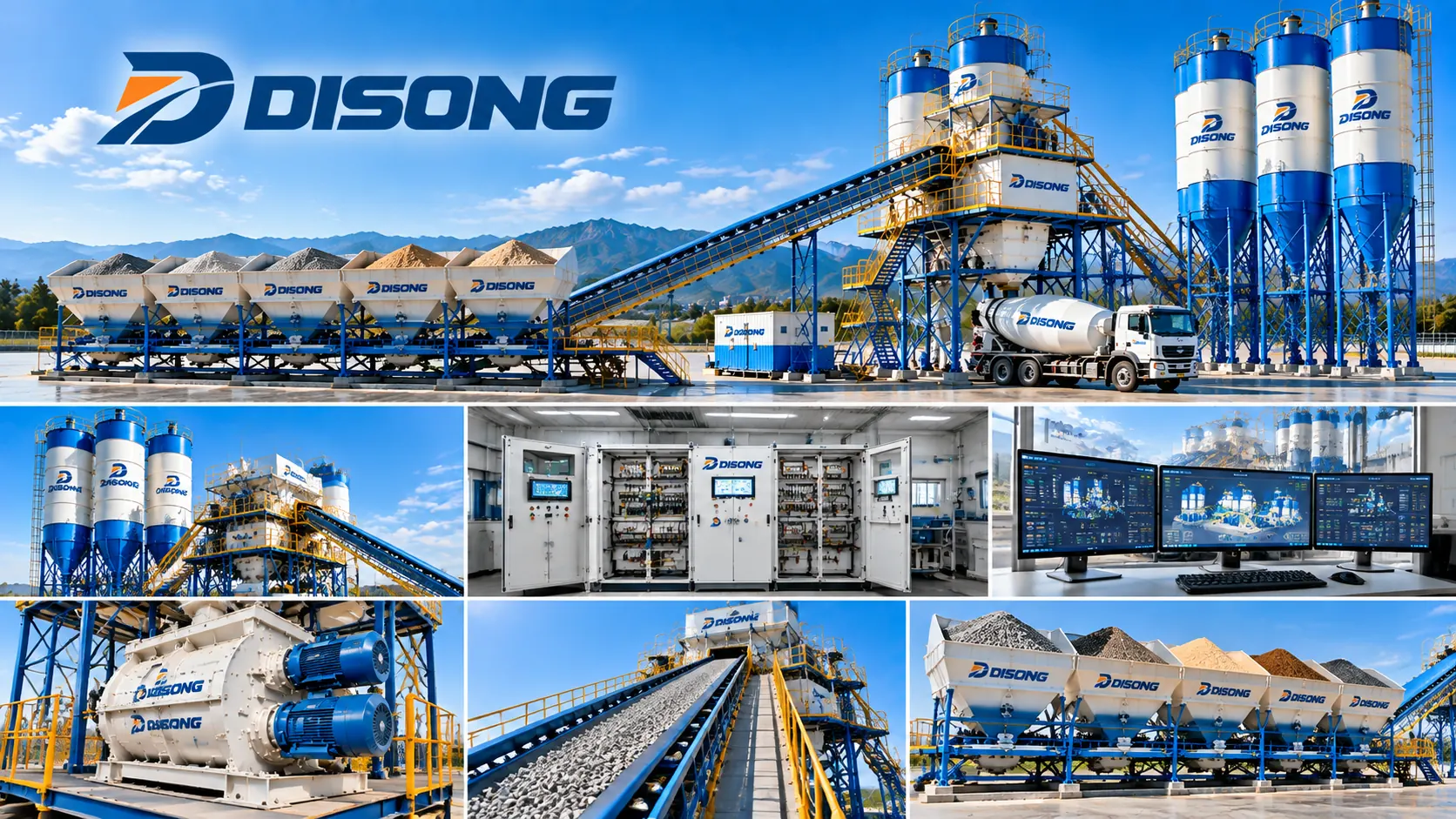
Data-centre and industrial-park projects buy concrete differently from ordinary building work. The mixes are specified and recorded, pours are long and continuous, and the same mix has to arrive consistent for hours rather than in one delivery. That changes which station you need — and, more often than not, what has to be settled before the order instead of after it.
Specified concrete, not just supplied concrete
A campus is built from slab-on-grade and raft pours, equipment plinths and service galleries, structural frames, and usually a share of precast elements produced at the same site. What the plant has to deliver is consistency: a slump that stays inside the specified band, weighing accuracy on every batch, and a control system that records what was actually batched. Where formwork has to come out and backfill follow quickly, early strength matters as much as the ultimate grade, and in a mass pour the mix has to stay workable long enough to place without the batch being retempered on site.
Continuous pours decide the capacity, not the average day
A large foundation or slab pour runs for hours with trucks queuing at the discharge point, so the station is sized for peak output rather than an average shift. That is why this kind of work usually shortlists the HZS90, HZS120 and HZS180, whose JS1500 to JS3000 mixers keep the discharge point moving, with the HZS50 to HZS75 range for enabling works, a precast yard or a package whose peak is genuinely lower. Cement storage is settled with the same question: the silos are what carry the pour across the gaps between deliveries.
Precast at the same site
Campuses frequently run a precast yard alongside the cast-in-place work, and the same station feeds both. A yard producing elements on a daily cycle needs batching accuracy and moisture compensation more than it needs headline capacity, and it needs covered aggregate storage so that the mix does not move with the weather from one day to the next.
A campus is built in phases, and the plant is the part that scales
Large campuses are almost never poured in one pass. The first building is topped out and fitted out while the next phase is still at foundation level, and the station stays on site across both — so the phase schedule, not the finished footprint, is what sizes it. Two consequences follow for the layout: the footprint should leave room for one more cement silo and a second aggregate bay, and the electrical package and control system should be specified so those can be added later rather than replaced. A station bought against the first slab alone usually ends up too small by the second phase, and the cost of that is a second site setup, not a spare machine.
What a 30 MW AI hall asks of the concrete
The AI halls being commissioned in the region now are a different pour from a conventional data centre. LG CNS said on 2 November 2026 that it had completed a 30 MW AI data centre in Jakarta, commissioned by KMG, a joint venture of Indonesia's Sinar Mas Group and Korea Investment Real Asset Management, built for next-generation GPUs on a hybrid air-and-liquid cooling design; the same announcement puts a next phase in design that would take the site's power capacity to 400 MW. Two things in that description reach the concrete rather than the IT: the rack loads the slab carries, and the volume of embedded services — cooling pipework, trenches, earthing — that has to be cast in before the pour closes.
What that changes at the plant is less the grade than the shape of the days. A floor with that much embedded work is poured in fewer and larger placements, because every construction joint is a detail that has to be repeated and inspected, and each of those placements holds the discharge point busy for hours. So the shortlist follows the peak rate, as it does on any campus, and the practical addition is supply resilience: a station that stops for a cement delivery in the middle of a placement leaves a cold joint in the floor rather than a late lorry. Sizing the silos against the interval the supplier can really hold — and holding a day of cement ahead of a placement — counts for more here than a wider model range.
The phase note above applies with force to a site announced as growing from 30 MW to 400 MW: that is a sequence of halls rather than one building's pour. A station bought for the first hall is the wrong size by the third, so a layout that leaves room for a second aggregate bay and one more silo is worth more than the saving on the smaller model.
Belt conveyor or skip hoist
Where the aggregate yard sits some distance from the mixer, or the site layout changes between phases, the aggregate usually arrives on a belt conveyor, as it does from the HZS60 upwards. A skip-hoist station such as the HZS50 needs less yard and no conveyor foundation. Settle this on the site plan early — it decides more of the layout than any other single choice.
The nine models and published prices
| Model | Capacity (m³/h) | Mixer | Aggregate batcher | Cement silo | Aggregate loading | FOB price from |
|---|---|---|---|---|---|---|
| HZS25 | 25 | JS500 | PLD800 | 1 x 50 t | Skip hoist | US$62,000 |
| HZS35 | 35 | JS750 | PLD1200 | 2 x 50 t | Skip hoist | US$80,000 |
| HZS50 | 50 | JS1000 | PLD1600 | 2 x 80 t | Skip hoist | US$109,000 |
| HZS60 | 60 | JS1000 | PLD1600 | 2 x 80 t | Belt conveyor | US$110,000 |
| HZS75 | 75 | JS1500 | PLD2400 | 2 x 100 t | Belt conveyor | US$122,000 |
| HZS90 | 90 | JS1500 | PLD2400 | 2 x 100 t | Belt conveyor | US$126,000 |
| HZS120 | 120 | JS2000 | PLD3200 | 2 x 100 t | Belt conveyor | US$168,000 |
| HZS180 | 180 | JS3000 | PLD4800 | 3 x 150 t | Belt conveyor | US$238,000 |
| HZS240 | 240 | JS4000 | PLD6400 | 4 x 200 t | Belt conveyor | US$320,000 |
What to confirm before ordering
Four things change the quotation: the site supply (voltage and frequency — the electrical package is built for the confirmed figure), the aggregate yard and storage arrangement, the destination port with its unloading crane capacity and inland access, and whether you want commissioning support quoted with the plant rather than arranged after shipment. Aggregate moisture compensation and covered storage are specified together, because they answer the same problem.
Frequently asked questions
Which plant does a data-centre project usually need?
It follows the pour plan rather than the size of the building. Long continuous pours push the shortlist to the HZS90 to HZS180 range, where the mixer and the aggregate batcher set the pace, and enabling works, precast yards or a smaller single package usually start at the HZS50 or HZS75. The nine models and their published FOB prices are on this page.
Is a wet-batch or a dry-batch plant the right choice?
Dry-batch stations discharge the weighed materials and the truck does the mixing, which suits sites close to the pour and buyers who want to keep the mixer on the road. Wet-batch stations mix centrally, which is the usual choice where the mix has to arrive consistent over a long pour and every batch has to be recorded. Which one you need is settled with the haul distance to the pour and the record the project asks for — send both and the configuration comes back on the quotation.
Can the same plant produce precast elements as well?
Yes. A yard producing elements on a daily cycle is fed from the same station, and what it needs is batching accuracy and aggregate moisture compensation rather than headline capacity. Covered aggregate storage is specified with it, because a mix that moves with the weather is the problem moisture compensation exists to solve.
The project is built in phases — should the plant be sized for the first building or the whole campus?
For the busiest phase, not the first one. A station bought against a single building's pour rate is usually too small by the time the second and third buildings are at foundation level, and replacing it means a second site setup rather than more equipment. What that asks for in practice is a model in the middle of the range — the HZS90 to HZS180 band — sited on a footprint that leaves room for one more silo and a second aggregate bay, with the electrical package and the control system written so those can be added later instead of replaced. Send the phase schedule with the first enquiry and the quotation can be written against the peak pour rather than the first slab.
How much cement storage should the plant carry?
It is set by how often cement can realistically be delivered and how many silos the supplier can discharge into at once. The table on this page lists the silo arrangement of each model, from 1 x 50 t on the HZS25 up to 4 x 200 t on the HZS240; too little storage stops the pour when a delivery is late.
Does an AI hall change the concrete specification compared with a conventional data centre?
The specification belongs to the project and is written around rack loads and embedded services, not around our equipment. What changes on our side is the pour sequence: a high-density rack floor with cooling pipework, trenches and earthing cast in is poured in fewer and larger placements, so the station is sized on the peak rate of those placements and on how long it can run without a cement delivery. Where the hall is one phase of a larger campus, the phase schedule is what the model choice is written against.
What has to be confirmed before the quotation?
Four things: the site supply (voltage and frequency — the electrical package is built for the confirmed figure), the aggregate yard and storage layout, the destination port with the unloading crane capacity and inland access, and whether you want commissioning support quoted with the plant.
Contact
DISONG Equipment LLC — Wyoming Limited Liability Company. Mailing address: 525 Randall Ave Ste 100, PMB 1419, Cheyenne, WY 82001, USA. Telephone/WhatsApp: +1 (213) 879-8221. Telegram: @disong_equipment_bot. Email: sales@disongequipment.com.
See also: price list · choosing a plant · for contractors · for ready-mix suppliers · Malaysia · Indonesia · data-centre projects in Malaysia · how a plant ships.
Terms of sale
Prices are FOB port of loading. Ocean freight, destination port charges, unloading and site-specific electrical work are quoted separately per shipment. Equipment is built to order, so returns are not accepted; delivery includes warranty service and spare-parts support from DISONG Equipment LLC.