Concrete batching plant for data-centre projects in Malaysia
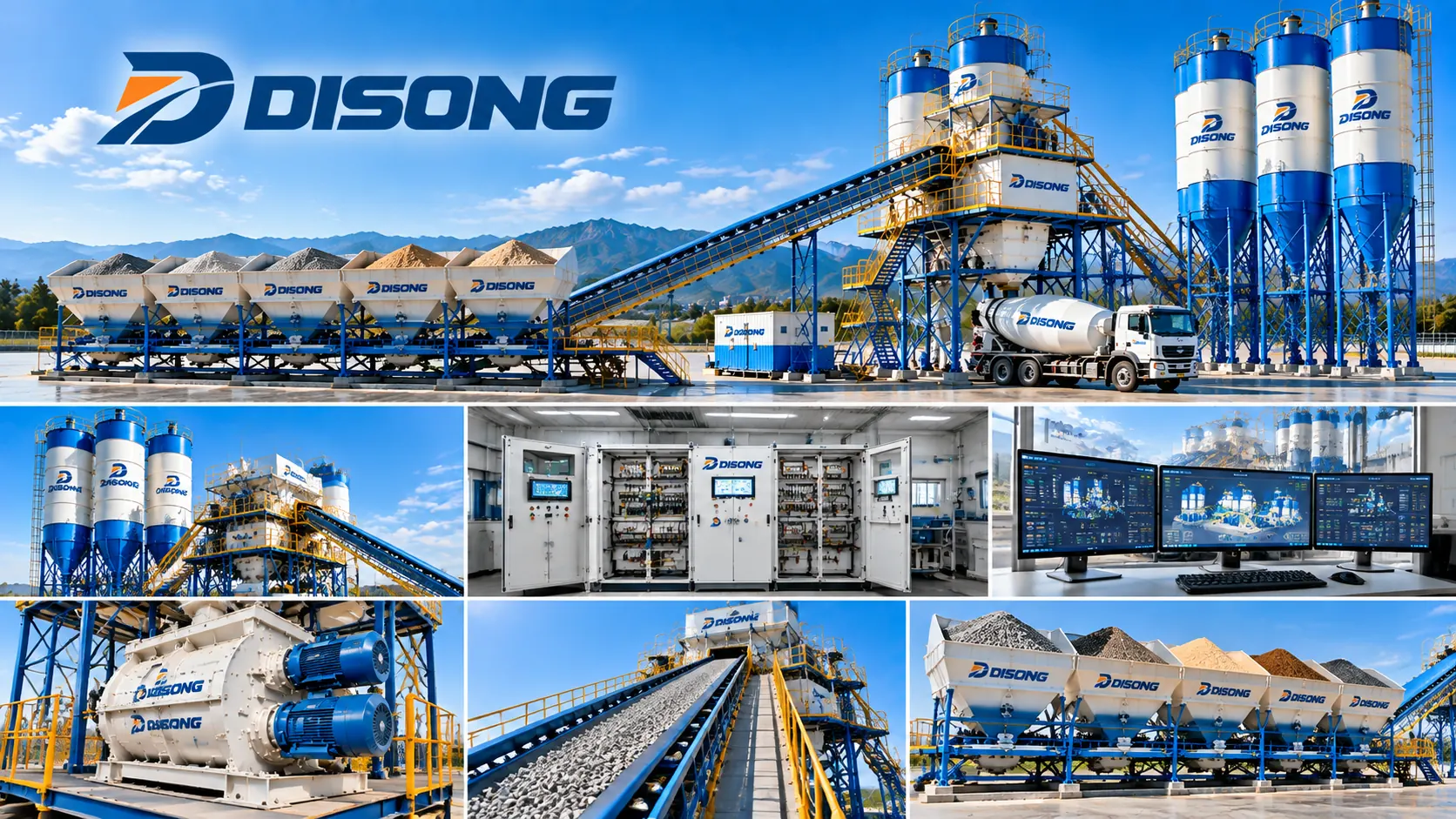
Malaysia’s data-centre pipeline is concentrated in two states — the Digital Ministry reported in October 2026 that 27 projects with an estimated investment of RM225.97 billion had been approved under the Data Centre Task Force, sixteen of them in Johor and ten in Selangor, with one operating and the rest still under construction. Behind every one of those campuses is a concrete programme that starts long before the server halls go up, and this page is about the station that feeds it.
The concrete behind a campus
A data-centre site buys concrete in three phases that rarely overlap. Enabling and civil works come first — platforms, access roads, drainage and retaining structures. Then the structural package: slab-on-grade and raft pours, equipment plinths, service galleries, and the supports for cooling-water and process pipework. Then the buildings around the halls, frequently with a precast or element yard on the same site. All three phases ask the plant for the same thing: a mix batched to its recorded weights, at a delivery rate the pour can absorb, with a control system that can show what was actually batched.
Capacity follows the peak pour, not the floor area
As on any project, the station is sized for the hour the pour needs it, not for the size of the campus. A raft or slab pour holds the discharge point busy with trucks queuing behind it, which is what usually shortlists the HZS90, HZS120 and HZS180, whose JS1500 to JS3000 mixers keep that point moving. Enabling works, a utility building or a single package whose peak is genuinely lower usually starts at the HZS50 to HZS75 range. Where the aggregate yard sits some distance from the mixer the material arrives on a belt conveyor, as it does from the HZS60 upwards; a skip-hoist station such as the HZS50 needs less yard and no conveyor foundation. Cement storage is settled with the same question — the silos are what carry the pour across the gaps between deliveries.
What a Malaysian site has to settle first
Three things decide the quotation before the plant does. The site supply: a 415 V / 50 Hz three-phase review is the usual starting point, and motors, control voltage, earthing and protection are engineered to the figure that is signed — a generator-fed site is part of the same review, not a separate one. The delivery arrangement: in Johor and the Klang Valley a campus is usually fed either by a ready-mix supplier running a dedicated plant or by the main contractor batching on site, and the on-site case is the one that has to settle its siting conditions early. The port and the inland leg: Port Klang, Penang or Pasir Gudang, with the unloading crane capacity and the road access to the pad confirmed before freight is quoted.
Siting: dust, noise and the council’s conditions
Batching on site removes a very large number of lorry movements from public roads, and that is the argument that gets an on-site plant approved inside a built-up area. The conditions attached to it are about what the plant emits at street level: dust, noise and the hours it runs. Those are engineering choices — covered or enclosed aggregate bins and a covered conveyor keep the yard from lifting dust in the wind, dust collectors at the silo tops and at the batching and transfer points capture what a fabric filter can capture, washdown water is collected rather than run to the drain, and a low-noise mixer with the noisiest points enclosed is what an early start or a night pour rests on. The permit terms, the monitoring plan and the permitted hours remain the operator’s own, and the plant is configured around them.
The local-content conditions on approved projects — a 30% minimum local-content requirement monitored by MIDA, and at least 3% of services sourced locally — are a procurement question for the project. What we supply is the equipment documentation those filings ask for: the specification, the drawings, the packing list and the electrical data.
The substation is poured before the server halls
On a Malaysian campus the first concrete package is often the power connection, not the building. On 13 October 2026 MN Holdings reported a RM293.88 million letter of award for two 275 kV consumer landing stations (CLS) serving a data-centre development in the central region of Peninsular Malaysia, covering the main building works and external works, with construction under way from September 2026 and completion scheduled for August 2027. A CLS is its own concrete programme — equipment plinths, cable trenches and duct banks, a control building, transformer and gantry foundations, and the yard and access works around them — and it runs while the server halls are still drawings. That has one practical consequence for the plant decision: the peak pour of the whole campus is not the peak pour of the year the plant is bought in. Sizing the station only for the halls leaves it idle through the enabling and substation months, and buying for those months alone is what usually shortlists the HZS50 to HZS75 range, or a ready-mix supplier running a dedicated plant at the campus edge. Which of the two it is stays a commercial decision of the contractor; what the equipment has to do either way is hold a recorded batch weight across a programme that changes shape three times.
A Johor campus let under one main contract
The corridor keeps producing contracts whose size changes how the concrete behind them is bought. The Edge Malaysia reported on 26 October 2026 that IJM Corp is understood to have emerged as the front runner for a contract worth about RM500 million to build a data centre in Johor for K2 Strategic Infrastructure Malaysia Sdn Bhd, a wholly-owned subsidiary of the Kuok group, and that the win would push IJM’s construction order book past the RM11 billion mark; the same report notes that K2 already operates two campuses at Kulai in Johor — JHR04 and JHR01–03 — with 234 MW of designed capacity. None of that is our project and none of it is ours to confirm. What it describes is the shape of the enquiry that keeps arriving: one main contractor, one campus, a programme counted in months rather than years.
That shape settles the plant decision before the pour schedule is written. The concrete is produced at the edge of the campus rather than hauled in from a commercial yard, because the haul is the first thing a fast-track programme runs out of; the station therefore has to go up inside the same window as the enabling works, which is what a bolted, containerised module buys and what a cast-in-situ foundation does not. Storage is the second consequence: one main contractor answers for every batch on the site, so the silos are sized against the delivery interval that contractor can actually hold rather than against a monthly cement total — a pour that stops because a tanker is late is a delay the programme cannot absorb.
The third is the record. A campus let under one contract submits its concrete evidence once, and what a plant contributes to that submission is the batch record itself: the weights actually batched, the moisture compensation applied, the mix, the time. A control system that prints and stores those per batch answers the quality submission directly; one that only shows a running total is a reconstruction afterwards. On a Malaysian site those figures sit beside the 415 V / 50 Hz supply review and the aggregate storage arrangement, which is why both are settled on the quotation instead of on site.
A build-only contract in Selangor, and a two-year programme
The contracts now arriving are written as build-only scopes, and that shape sets a station’s life as much as its size. On 5 November 2026 Sunway Construction Group Bhd reported to Bursa Malaysia that its wholly-owned subsidiary had signed a construction agreement with an international hyperscaler — the customer was not named — for a build-only contract worth RM1.739 billion to build a hyperscale data centre at Bandar Serendah in Selangor, covering the core and shell structures, campus infrastructure and mechanical, electrical and plumbing fit-out, with work starting in the fourth quarter of 2026 and completing in the fourth quarter of 2028 (BERNAMA, 5 November 2026; the same award was reported by The Edge Malaysia and The Star the same day). The day before, the same contractor had booked a RM920.8 million variation order from a US-headquartered technology corporation for additional MEP fit-out works at a Johor campus already under construction, running to the first quarter of 2028 (The Malaysian Reserve and The Star, 4 November 2026). Neither project is ours and nothing here should be read as a claim to it; what the two filings describe is the concrete programme one station has to cover.
Read the scope as a pour sequence. Core and shell is the visible part — rafts, slab-on-grade, plinths and the substructure under the halls — but campus infrastructure adds the roads, drainage, retaining structures and utility corridors around them, and MEP fit-out adds the trenches, duct banks, cast-in floor openings and equipment bases that are poured after the building is up. Those three do not arrive together. They run across the whole window, and on a shell-only job the fit-out pours would come back long after the yard had been demobilised. A station kept through the full programme is therefore specified for the middle of the range rather than for its worst week: the footprint and the electrical package are written so a second silo and a second aggregate bay can be added instead of replaced, and the structure is bolted and containerised if the campus is built in parcels the plant has to follow. The variation order carries the same lesson from the other direction — a fit-out variation booked part-way through a job extends the concrete tail, which is why cement storage and the ability to re-site are settled on the quotation rather than assumed.
Rain, humidity and aggregate moisture
Malaysian sites work through the rain, so the mix is the part that needs attention rather than the schedule. Aggregate moisture moves with the weather through the day and from stockpile to stockpile, which is exactly what real-time moisture compensation exists to correct against the recorded batch weights. Covered aggregate storage, yard drainage and moisture compensation are specified together for that reason — a plant that batches by weight on dry figures will not hold its slump through a wet afternoon.
The nine models and published prices
| Model | Capacity (m³/h) | Mixer | Aggregate batcher | Cement silo | Aggregate loading | FOB price from |
|---|---|---|---|---|---|---|
| HZS25 | 25 | JS500 | PLD800 | 1 x 50 t | Skip hoist | US$62,000 |
| HZS35 | 35 | JS750 | PLD1200 | 2 x 50 t | Skip hoist | US$80,000 |
| HZS50 | 50 | JS1000 | PLD1600 | 2 x 80 t | Skip hoist | US$109,000 |
| HZS60 | 60 | JS1000 | PLD1600 | 2 x 80 t | Belt conveyor | US$110,000 |
| HZS75 | 75 | JS1500 | PLD2400 | 2 x 100 t | Belt conveyor | US$122,000 |
| HZS90 | 90 | JS1500 | PLD2400 | 2 x 100 t | Belt conveyor | US$126,000 |
| HZS120 | 120 | JS2000 | PLD3200 | 2 x 100 t | Belt conveyor | US$168,000 |
| HZS180 | 180 | JS3000 | PLD4800 | 3 x 150 t | Belt conveyor | US$238,000 |
| HZS240 | 240 | JS4000 | PLD6400 | 4 x 200 t | Belt conveyor | US$320,000 |
What to confirm before ordering
Four things change the quotation: the site supply (voltage and frequency — the electrical package is built for the confirmed figure), the aggregate yard and storage arrangement, the destination port with its unloading crane capacity and inland access to the site, and whether you want assembly and commissioning support quoted with the plant rather than arranged after shipment.
Frequently asked questions
Which plant does a data-centre project in Malaysia usually need?
It follows the pour plan, not the size of the campus. The structural package — slab-on-grade and raft pours, equipment plinths and service galleries — holds the discharge point busy for hours, which puts the shortlist in the HZS90 to HZS180 range; enabling and civil works, a utility building or a precast yard usually start at the HZS50 or HZS75. The nine models and their published FOB prices are on this page.
Do the local-content conditions on approved data-centre projects apply to the equipment?
That is a procurement question for the project, not something a supplier can answer for you. The Digital Ministry said in October 2026 that projects approved under the Data Centre Task Force carry a minimum local-content requirement of 30%, monitored by MIDA through six-monthly implementation reports, and that at least 3% of services — consultancy, contracting, engineering and legal — are to be sourced locally. What we do is supply the equipment documents the filing asks for: specification, drawings, packing list and electrical data.
What supply does the plant need in Malaysia?
A 415 V / 50 Hz three-phase review is the usual starting point; motors, control voltage, earthing and protection are engineered to the signed site data, and the connected load for your configuration is stated on the quotation. Where the site runs on generator sets, that is part of the same review rather than a separate question.
Which port do you ship to, and what happens after it lands?
Port Klang, Penang or Pasir Gudang, depending on where the campus is. Ocean freight, port handling, customs clearance and inland haulage are quoted as separate lines, and the unloading crane capacity at the destination and the road access to the site are confirmed before freight is quoted — a module that cannot be lifted or cannot reach the pad is a planning problem, not a shipping one.
Does the rain stop production?
The plant runs in the rain; mix accuracy is the part that needs attention. Aggregate moisture moves with the weather through the day, so real-time moisture compensation and covered aggregate storage are specified together with drainage for the yard.
The campus is let under one main contract - does that change what we buy?
It changes the coordination rather than the equipment. One main contractor answers for every batch on the site, so the plant is specified against a single pour programme and a single quality record instead of several subcontractors' schedules: the batch record has to be submittable, the silo storage has to cover the cement delivery interval that contractor can actually keep, and the siting conditions are negotiated alongside the temporary-works approval, which happens earlier than most buyers expect. Send the pour programme, the cement delivery interval and the council conditions with the enquiry and the configuration is written against all three.
Can a plant be sited inside a built-up area?
Dust and noise are what local councils enforce on — in October 2026 Kuala Lumpur City Hall sealed a temporary batching plant after residents complained about both, and it had been approved on the grounds that it cut lorry movements on public roads. So the council's conditions for the plot are settled before the layout, not after. On the equipment side that means covered or enclosed aggregate bins, a covered conveyor, dust collection at the silo tops and at the batching and transfer points, controlled washdown water, and a low-noise mixer with the noisiest points enclosed. The permit terms, the monitoring plan and the permitted hours stay the operator's own — send them with the enquiry and the plant is configured around them.
Should the plant be sized for the server halls or for the first phase of the campus?
For the peak pour of the programme you are actually buying it for. The enabling and substation works — a 275 kV CLS is its own concrete package of plinths, cable trenches, a control building and yard works — run a year or more before the halls reach their heaviest rafts, and a station bought for the halls alone sits idle through that period. Sites that expect the hall peaks later and want one station throughout usually start in the HZS90 to HZS120 range; a contractor covering only the early works, or a ready-mix supplier adding a plant at the campus edge, is usually better served by the HZS50 to HZS75 range. Send the pour schedule with the enquiry and the configuration follows it.
The contract is build-only and runs two years - does that change what the plant has to be?
It changes the station's life rather than its headline capacity. A build-only scope that covers core and shell, campus infrastructure and MEP fit-out puts concrete on the site at three separate points in the programme - enabling and substructure, the structural package, and then trenches, plinths and equipment bases during fit-out - so a station bought for the structural phase alone is either idle at the start or short when the fit-out pours come back. Sites that keep one station across the whole window usually buy in the HZS90 to HZS180 band, leave room for one more silo and a second aggregate bay, and choose a bolted, containerised structure if the campus is built in parcels the plant has to follow. Send the phase schedule and the fit-out scope with the enquiry and the configuration is written against both.
Contact
DISONG Equipment LLC — Wyoming Limited Liability Company. Mailing address: 525 Randall Ave Ste 100, PMB 1419, Cheyenne, WY 82001, USA. Telephone/WhatsApp: +1 (213) 879-8221. Telegram: @disong_equipment_bot. Email: sales@disongequipment.com.
See also: data-centre and industrial-park concrete · Malaysia · price list · for contractors · for ready-mix suppliers · choosing a plant · how a plant ships.
Terms of sale
Prices are FOB port of loading. Ocean freight, destination port charges, unloading and site-specific electrical work are quoted separately per shipment. Equipment is built to order, so returns are not accepted; delivery includes warranty service and spare-parts support from DISONG Equipment LLC.