Concrete batching plants for Egypt — ready-mix, new-city and industrial projects
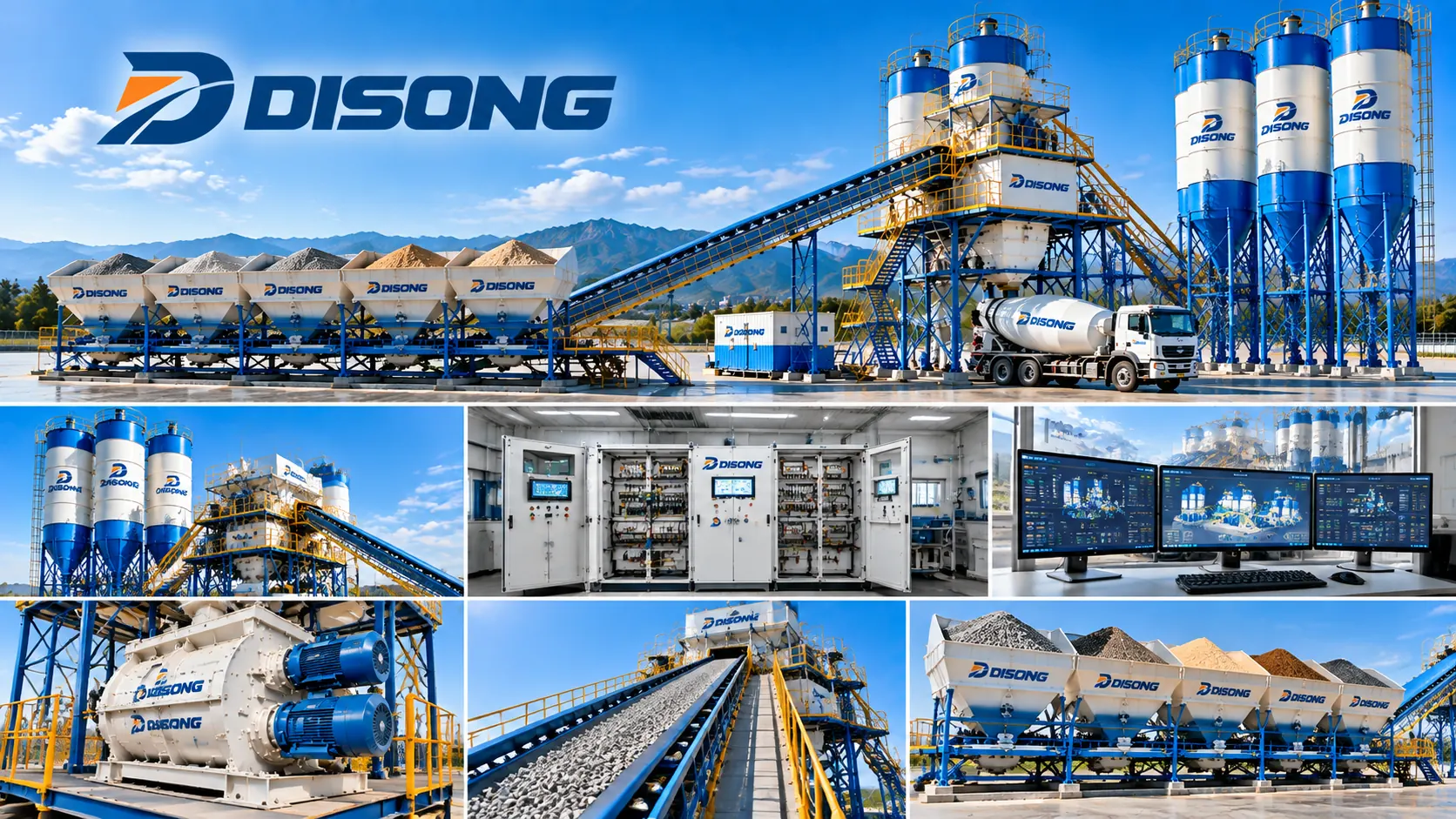
Egyptian demand is expanding with new-city, housing and industrial programmes, while high summer temperatures, dust and imported spare-part logistics decide how the plant is configured and how it is supported after installation.
The range we supply
Nine models from HZS25 (25 m³/h) to HZS240 (240 m³/h), with published FOB prices from US$62,000 to US$320,000 for the standard configuration — the full table is on the price page. Every plant ships containerised, broken down so the modules follow the site assembly sequence and can be moved on to the next project.
Power supply
Egyptian installations normally need a 380 V / 50 Hz three-phase review — including generator operation while the grid connection is still being extended; motors, control voltage, earthing and protection follow the confirmed site supply.
Climate and site conditions
Specify the summer temperature range, dust and sand exposure, water supply, aggregate moisture variation, covered storage and control-room cooling.
Ports and inland transport
Alexandria, Damietta, Port Said or Sokhna, plus inland haulage to the new cities, unloading crane capacity and road access, are confirmed before freight is quoted.
Import documents and standards
Imports into Egypt require a Certificate of Conformity, with registration through GOEIC; those filings are handled on the Egyptian side. We prepare the equipment documents the inspection body asks for — specification, drawings, packing list and nameplate data — so the conformity assessment is not held up by missing paperwork.
The Sinai rail corridor — what a 341 km line asks of concrete supply
Egypt's Transport Ministry is pushing the Bir al-Abd–Arish–Ras al-Naqab railway, a 341 km line that ends at Taba Airport and forms part of a 500 km Ferdan–East Port Said–Bir al-Abd–Arish–Taba corridor — one of eight integrated development and logistics corridors the ministry is building. On 2 November 2026 it reported track-laying under way on the 83 km Bir al-Abd–Arish section with eleven Egyptian companies on the embankment works, seven stations (El-Sadat, El-Toloul, Martyrs of Al-Rawda, Salt Factory, Masaeed, Sinai–Central Arish and Arish Airport), nine road-crossing bridges, one railway bridge and two tunnels, with 258 km of the corridor still to be built across desert terrain (Daily News Egypt, 2 November 2026; Construction Review, 3 November 2026). Two 12 km branch lines tie the railway to Arish Port and to a cement factory, and the port package includes four cement silos of 40,000 t total capacity, with a logistics zone planned behind the port for 1,000 factories. For concrete supply that shape of work is three different problems rather than one: a precast yard casting sleepers and bridge elements on a daily cycle, cast-in-place pours for stations, bridges and tunnel portals, and a port and industrial zone that keeps drawing concrete long after the line opens. A yard on a desert corridor normally sits far from any commercial ready-mix plant, which is what puts a station beside the works instead; the constraints that then decide the configuration are water and aggregate haul, cement arriving over a long inland leg — silo capacity against the delivery interval the site can really keep, not a monthly total — dust and heat at the batching and transfer points, and a layout that can be taken down and re-erected when the section moves on. Capacity still follows the peak pour rather than the length of the corridor; the length decides how many times the plant is relocated.
Where these plants are used in Egypt
Commercial ready-mix, new-city and housing programmes, roads and bridges, industrial works, water and utility plants, and precast production.
Frequently asked questions
Which capacity suits an Egyptian ready-mix operation?
A district yard normally starts on HZS50–HZS75, a city operation on HZS120, and a high-volume plant serving a new-city or infrastructure programme on HZS180–HZS240. Where the site is still on generator power, the electrical package is quoted for that duty.
Can the plant run on a generator?
Yes — generator operation is a normal case in Egypt while a grid connection is being extended, and the electrical package is specified for it. Confirm the supply you will run on, and the connected load for your configuration is stated on the quotation.
What documents are needed to import into Egypt?
A Certificate of Conformity is required for imports, with registration through GOEIC, and those filings are made on the Egyptian side. We prepare the specification, drawings, packing list and nameplate data the inspection body asks for.
Which port do you ship to?
Alexandria, Damietta, Port Said or Sokhna, depending on the destination. Ocean freight, port handling, customs clearance and inland haulage to the new cities are quoted as separate lines.
A corridor yard in desert terrain, far from any ready-mix plant — what does that change?
It makes the plant the concrete supply rather than a backup to one, so three things move up the specification. Water: batching water is a stored quantity on a site that has no mains supply, and washdown water is collected with the surplus recycled rather than run off. Cement: the silos are sized against the delivery interval a long inland haul can actually keep, not against a monthly tonnage, because a station that runs dry between deliveries loses the pour whatever its rated output. Heat and dust: covered or enclosed aggregate bins, a covered conveyor and dust collection at the silo tops and at the batching and transfer points, with the control room cooled for the summer range you confirm. Where the grid has not reached the yard, the electrical package is quoted for generator duty and the connected load is stated on the quotation.
The corridor is built in sections — does the plant move with it?
Usually, and the layout is what decides whether that costs a week or a month. A package station is taken down and re-erected when the section finishes, so foundations, conveyor supports and control wiring that can be lifted and reused belong in the specification from the start, and a skid or containerised arrangement is what makes the relocation routine. Send the largest single pour, the number of sections you expect to move between and the cement delivery interval, and the configuration follows from those three.
Contact
DISONG Equipment LLC — Wyoming Limited Liability Company. Mailing address: 525 Randall Ave Ste 100, PMB 1419, Cheyenne, WY 82001, USA. Telephone/WhatsApp: +1 (213) 879-8221. Telegram: @disong_equipment_bot. Email: sales@disongequipment.com.
See also: price list · metro, tunnel and highway concrete · data-centre and industrial-park concrete · data-centre projects in Malaysia · HZS60 specifications · HZS120 specifications · how a plant ships · request a quotation.
Other markets we supply: Indonesia · Malaysia · the Philippines · all HZS models.
Terms of sale
Prices are FOB port of loading. Ocean freight, destination port charges, unloading and site-specific electrical work are quoted separately per shipment. Equipment is built to order, so returns are not accepted; delivery includes warranty service and spare-parts support from DISONG Equipment LLC.