Mobile batching plant for road and highway projects
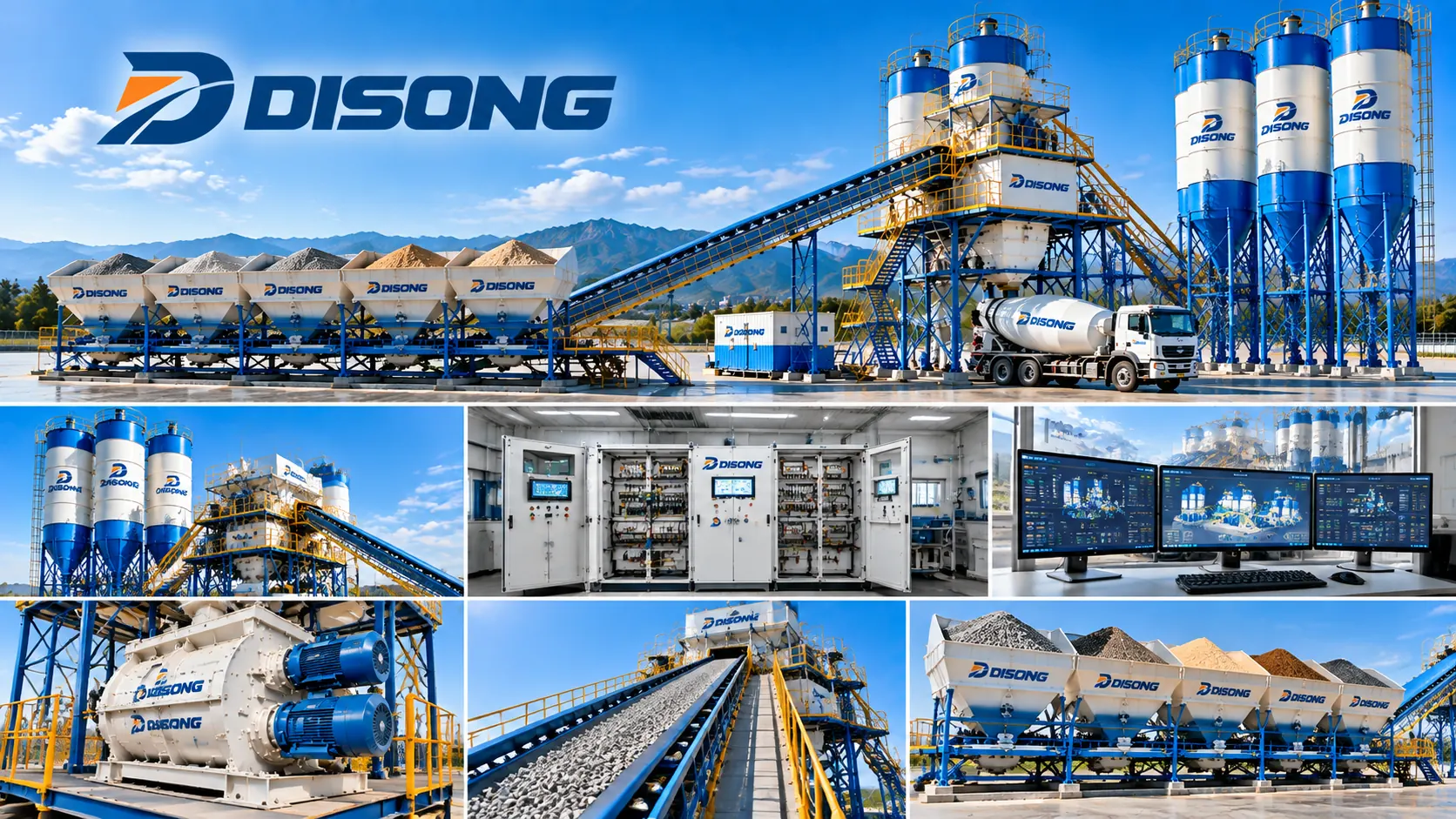
A road job does not have one plant location. It has a moving front: the pavement train works a few hundred metres a day, and anything that feeds it has to keep up without hauling concrete back and forth across the site. That is the whole case for a mobile or modular batching plant — the plant travels with the work, not the concrete.
What "mobile" actually means in practice
There is no single definition, and the difference matters when you compare prices. Three arrangements are sold as mobile:
- Trailer or skid-mounted mixer unit — a pan or twin-shaft mixer on a steel frame with its own cement hopper and water meter. Fast to move, small output, normally fed by loader and bags or a separate silo.
- Modular station — aggregate bins, weighing hoppers, inclined belt, mixer and control cabin built as bolted modules that travel on flatbed trailers and are re-erected on a levelled pad in days. This is the arrangement most road packages end up with when the daily volume is real.
- Fixed station that is simply small — permanently founded, cheap to buy, expensive to move. Called mobile by the seller, not by the site engineer.
Ask which one you are being quoted. A modular station and a fixed station can carry the same HZS model number and differ completely in what it costs to relocate.
Sizing to the pavement, not to the project total
The number that decides the model is the daily pour, not the contract volume. A single-lane pavement train placing 300–500 m of slab a day sits comfortably behind an HZS50 or HZS60; a dual-lane run with a wider paving width, or a job that also feeds structures and culverts, moves to the HZS75 or HZS90. Anything above that is usually a project that has stopped being a road job and become a corridor with a fixed plant beside it.
Two constraints usually cut the shortlist faster than output does: the loader has to be able to turn inside the pad, and the mixer truck has to be able to reverse to the discharge point without blocking the paving train. Both are layout questions, and both are answered on the drawing before a machine is chosen.
Relocation: what actually costs the days
Moving a modular station is not one lift. The realistic sequence is: pour or prepare a level pad at the new location, strip and load the modules, haul, re-erect, re-level the bins and belt, reconnect power, re-anchor the silo, then re-commission and run a trial batch. On a prepared pad with the same crew this is a matter of days; on a fresh site it is a matter of weeks, and the pad is almost always the long pole.
That is why the relocation plan should be drawn at the tender stage: how many moves the job will need, where each pad goes, and whether the silo is designed to be split into transport sections. A silo that has to be cut down to move is not a mobile asset.
Power, dust and the neighbours
Road works run where the grid is thin. A station in the HZS50–HZS90 range is normally specified with a generator-sized supply and a control system that tolerates voltage swing; on some sites the generator is the primary supply for the whole spread. Dust at the bins and at the cement intake is the other recurring condition — filter units on the silo and a spray bar at the discharge are not extras on a road job next to a village.
A dedicated plant, or a mixer on the back of a truck?
Road authorities are making that comparison in public. In November 2026 a contractor building a toll-road section in Central Java set up a batching plant dedicated to that section rather than drawing concrete from a commercial yard (Datapost, 2 November 2026), while in North Sumatra a road retaining-wall package was reported to be running on a truck-mounted mixer instead of a batching plant, with volume and payment questions raised around it (Kantongberita, 3 November 2026). Neither report is about a plant we supplied. They describe the same decision from two sides: on a linear job, concrete placed from a dedicated station is metered, recorded per batch and delivered inside its workability window, and that is what a public-works inspector is checking. A mixer mounted on a truck can place concrete — it cannot weigh four aggregates separately, hold a mix design, or print a ticket per batch.
What to fix before ordering
- Daily and peak pour in m³, and how many moves the job needs
- Whether the pad is prepared by you or to the station supplier's drawing
- Site voltage and whether a generator carries the plant
- Cement delivery method — bulk tanker or bags — and silo tonnage per move
- Aggregate sizes and how many bins the mix designs actually need
Send those five answers with the site layout and the model can be fixed with the plant footprint already checked against the pad. Published FOB price ranges are on the price page, and the country pages cover Indonesia, the Philippines and Malaysia.
Terms of sale
Prices are FOB port of loading. Ocean freight, destination port charges, unloading and site-specific electrical work are quoted separately per shipment. Equipment is built to order, so returns are not accepted; delivery includes warranty service and spare-parts support from DISONG Equipment LLC.