Batching plant retrofit, rebuild and spare parts
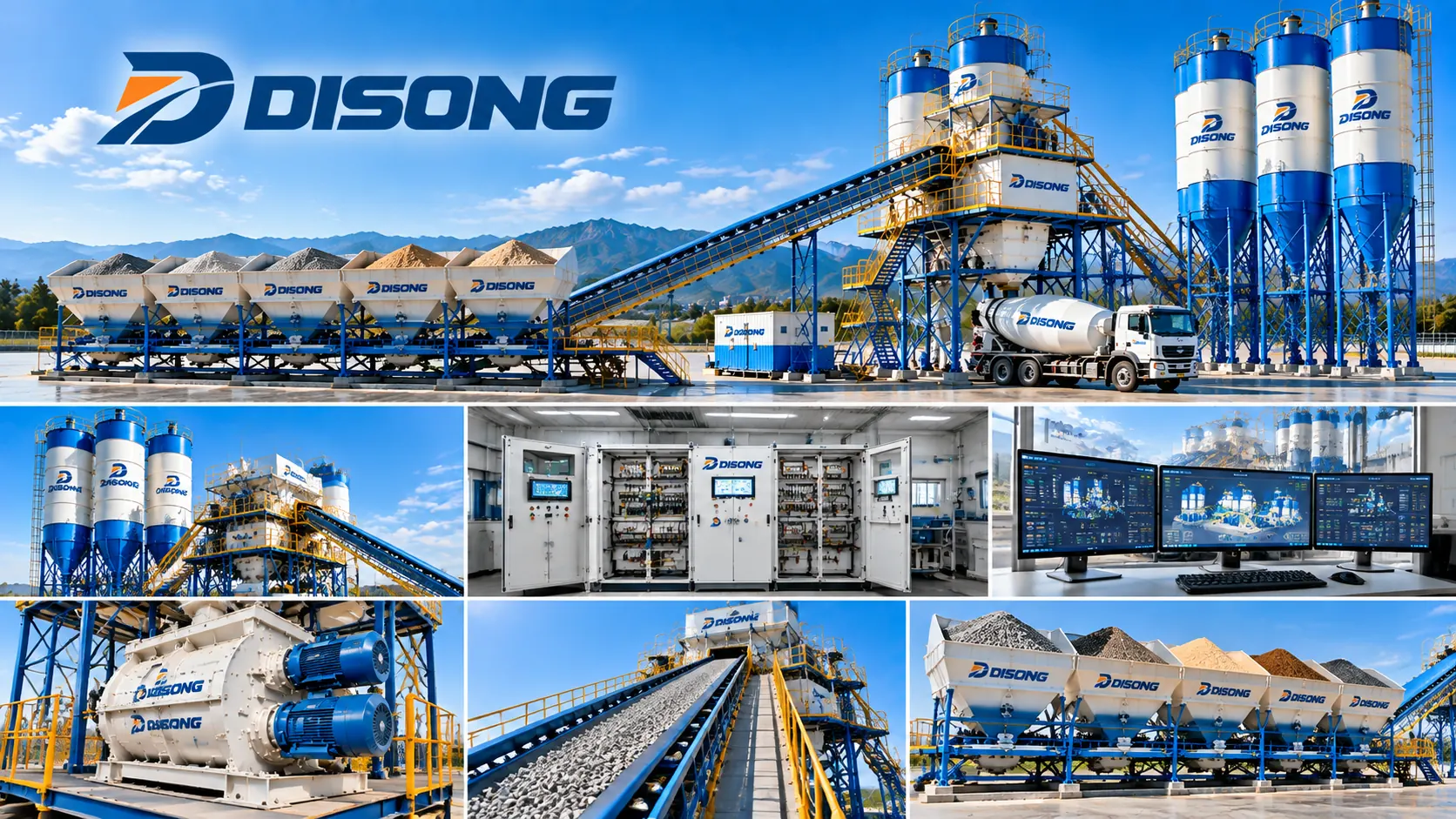
A concrete batching plant that has stopped earning is usually not worn out. The frame, the bins, the silos and the foundations are built to outlast several sets of the parts that do the work, and replacing the station because a liner is through or a load cell has drifted is the most expensive way to solve a maintenance problem. What follows is what actually wears, how a retrofit is scoped, and what the enquiry needs to contain.
What actually wears
The list is short and it repeats on every station: the mixer's liners and mixing blades, the skip rope, winch and its rails where the plant loads by skip, the conveyor belt, rollers and pulleys where it loads by belt, aggregate bin gates and vibrators, the weighing load cells and their mountings, the cement screw conveyors, butterfly and knife gates and aeration pads, the dust collectors on the silo tops and at the transfer points, the water and admixture pumps and valves, and on the electrical side the contactors, the PLC input and output modules and the wiring that has been baked by the panel's own heat for years. None of that is the structure.
A retrofit is scoped against your parts list, not against a catalogue
Two stations of the same model, one run at 60 m3/h for eight years and one at 30 m3/h for three, do not need the same work, so a retrofit is not sold as a kit. It is scoped from the wear that is actually there: the parts list or the last spare-parts order, the measurements you can take, and photographs of the worn areas in place. That is also what makes the quotation comparable — every item on it corresponds to something on your plant rather than to a package that has to be trimmed afterwards.
The decision is the frame, not the price of the parts
What decides between a rebuild and a new station is not a percentage. It is whether the frame and the foundations are sound, whether the existing capacity still matches what the market is asking from the plant, whether the electrical package still satisfies the site's supply and protection requirements, and how much concrete storage the site can hold. A station that is sound but undersized needs a second line or a larger mixer, not liners; one that is the right size but worn needs the wearing parts and nothing else. Both are quoted against the same scope so the choice can be made on the site's own numbers.
Keeping the plant producing while the work is done
Most of this work is sequenced rather than shut down. Wearing parts are replaced one line at a time between pours where the layout allows it, the parts are staged on site before the window opens, and the larger items — a mixer shell, a conveyor, a control panel — are planned around the pour calendar the plant is working to. What that needs from the enquiry is the calendar, not just the parts list.
Your crew with drawings and parts, or our engineers on site
Both are normal. A crew that has maintained the plant for years can do the replacement work with our parts and drawings, and many customers prefer it because the plant never leaves their own control. For a full rebuild the engineers can join the work on site, quoted as part of the scope rather than arranged afterwards. Which one suits a given plant is a site decision, and the drawings and part numbers are the same either way.
Spare parts held against the same plant
The parts are produced for the plant they belong to, which is what makes a second order a repeat rather than a re-measurement: liners, blades, belts, rollers, load cells, gates, screw conveyors, dust collectors and the electrical items are quoted against the station's own configuration. Parts are packed for sea freight, and the packing and marking are stated on the quotation together with the port of loading.
What to send with the enquiry
Four things settle the scope: the plant model and mixer type — a photograph of the nameplate is the quickest way to give both — the wear list or the last spare-parts order, the site supply in volts and hertz, and the destination port with its unloading crane capacity and inland access. Photographs of the wearing areas are worth more than a description, and the production window you can offer decides the schedule.
Frequently asked questions
Can you supply parts for a plant another manufacturer built?
Yes, quoted against your own parts list. What decides it is the drawing, the material and the mounting rather than the name on the panel, so the enquiry needs the part number or marking, the dimensions you can measure and a photograph of the worn part in place. Nothing is assumed interchangeable: where the fit has to be checked, it is checked before the part is quoted, not after it arrives.
Is a rebuild cheaper than a new plant?
It depends entirely on how much of the station is worn, and that is settled by the scope rather than by a rule of thumb — no figure is published here because it would be a guess for your plant. What the quotation does is set the two options against the same scope: the worn parts replaced on the existing frame, or a new station, each with its own schedule and its own effect on production.
How long is the plant out of production?
It follows the scope and, more often, the production window you can give. Wearing parts and components are replaced one line at a time between pours where the layout allows it, and a larger rebuild is planned around the calendar you are working to. The schedule is agreed with the quotation; this page does not promise a number of days, because the honest number comes out of your site and your pour calendar.
Do you sell wearing parts on their own, without any service agreement?
Yes. Liners and mixing blades, skip ropes and winch parts, conveyor belts, rollers and pulleys, bin gates and vibrators, load cells, cement screw conveyors, dust collectors, and the water and admixture valves are all quoted as parts. No service contract is required to buy them.
Which models does this cover?
The nine HZS models published on this site, from the HZS25 to the HZS240, including the mixer, batcher, silo and control package that goes with each. For a station of another make the parts are quoted against your drawings and parts list, as described above.
What has to be confirmed before the quotation?
Four things: the plant model and mixer type (a photograph of the nameplate is the quickest way), the wear list or the last spare-parts order, the site supply in volts and hertz, and the destination port with its unloading and inland access. Photographs of the wearing areas settle more of the scope than a description does.
Contact
DISONG Equipment LLC — Wyoming Limited Liability Company. Mailing address: 525 Randall Ave Ste 100, PMB 1419, Cheyenne, WY 82001, USA. Telephone/WhatsApp: +1 (213) 879-8221. Telegram: @disong_equipment_bot. Email: sales@disongequipment.com.
See also: published FOB prices by model · how a plant and its parts ship · choosing a plant · for ready-mix suppliers · for contractors · HZS90 · HZS120.
Terms of sale
Prices are FOB port of loading. Ocean freight, destination port charges, unloading and site-specific electrical work are quoted separately per shipment. Equipment is built to order, so returns are not accepted; delivery includes warranty service and spare-parts support from DISONG Equipment LLC.